Transforming Metal into Art: The Innovative World of Fold Forming Techniques
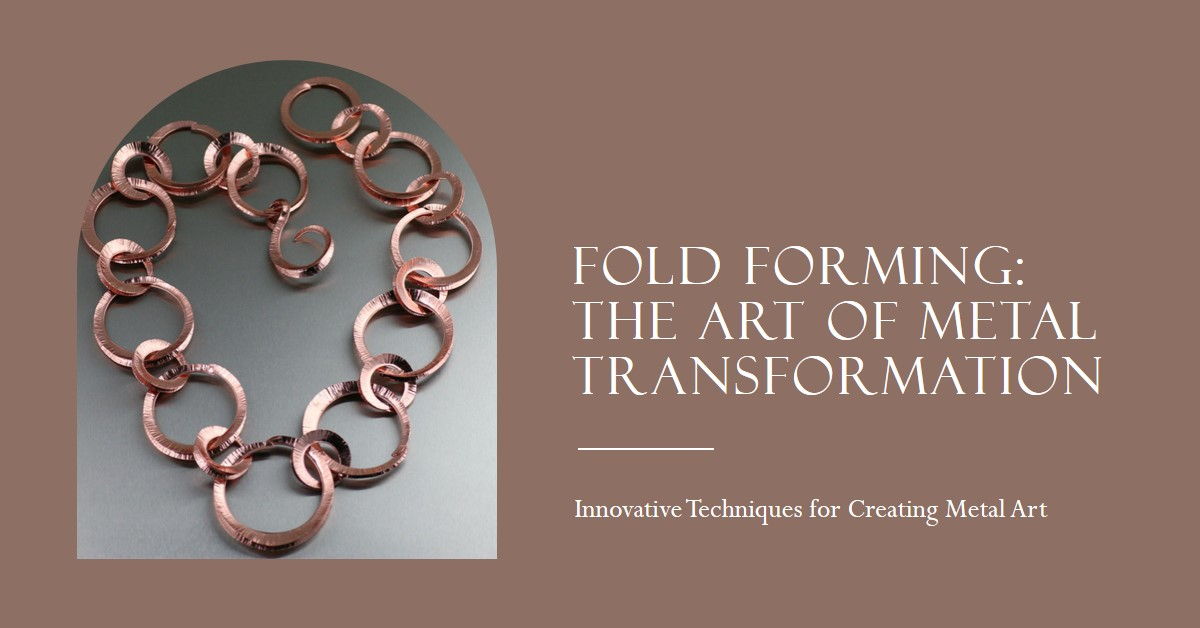

Fold forming is a revolutionary technique in jewelry design that allows artists to create complex, three-dimensional shapes from metal sheets. This method involves folding, hammering, and unfolding the metal to achieve intricate designs that are both lightweight and strong. Materials supplied for fold forming typically include copper, brass, and sterling silver.
Key Takeaways
- Fold forming shapes a single sheet of metal into 3D forms by folding, hammering, annealing and unfolding it, with no soldering.
- The technique was developed and pioneered by metalsmith Charles Lewton-Brain in the 1980s.
- Basic folds include T-folds, line folds and cross folds, which can be combined into endless new shapes.
- Hammering work-hardens the metal and folds add stiffness, so fold-formed pieces are light yet strong.
- John S. Brana uses fold forming in copper and aluminum cuffs, leaf earrings, lily pad earrings and necklaces.
DESIGNING JEWELRY BY FOLD FORMING WITH CHARLES LEWTON BRAIN
Fold forming is a collection of techniques developed and pioneered by Charles Lewton-Brain. These fold forming techniques are now being used in a wide array of jewelry styles, from earrings to bracelets. During the process of fold forming, sheets of metal are hammered and annealed into three-dimensional shapes without any soldering. While only a couple decades old – hailing back to the 1980s – this metalsmithing process employs metal’s plasticity to create complex forms.

Fold forming has become widely recognized as a new approach to jewelry-making and metal-working all over the world. Modern fold forming is considered a combination of traditional metalwork and origami. It’s about allowing the metal to fold in natural ways according to its plasticity, instead of forcing form. When one does not fight to form the metal, forming becomes extremely rapid and efficient. Highly complex relief forms can be produced with just a single sheet of metal and a few tools, including your hands, fingers, mallets, hammers, anvils, rolling mills, and hydraulic press.

Fold forming techniques can be used with a wide range of metals, including steel, niobium, and aluminum. The technique involves folding, working, and then unfolding the metal to create complex and intricate forms without the need for soldering, making it applicable for jewelry and other metalwork. They are often used in enameling, holloware, and jewelry as there is no soldering required. Fold forming metal can be combined with chain maille and fabricating metal leaves to create unique jewelry pieces with texture and color.

Who Is Fold-Formed Jewelry For?
This guide is for jewelry lovers who want sculptural, one-of-a-kind pieces, for gift buyers looking for something more distinctive than mass-produced jewelry, and for anyone curious about how handmade metal jewelry is made. Fold-formed jewelry is a good choice when:
- You want bold earrings that stay light – folding adds volume and texture without adding much metal.
- You want everyday statement jewelry – work-hardened folds hold their shape through regular wear.
- You are shopping for a meaningful gift – every fold-formed piece is slightly different, and copper is the traditional 7th wedding anniversary gift.
- You love nature-inspired design – fold forming naturally produces leaf, shell and petal shapes.
How Does Fold Forming Work, Step by Step?
- Anneal the sheet. The metal is heated to soften it. For copper, this is typically a dull red heat of roughly 500 to 650°C, according to guidance from the Copper Development Association.
- Fold the metal. The softened sheet is folded, often simply in half, to set up the form.
- Forge the fold. The folded edge is hammered or rolled, which stretches one side of the metal and makes the piece curve.
- Anneal again. Hammering hardens the metal, so it is softened again before the next step.
- Open the fold. The metal is unfolded to reveal a three-dimensional form, such as a leaf with a raised central vein.
- Finish the piece. The form is shaped, textured, patinated or polished and made into earrings, cuffs or pendants.
| Fold | What It Does | Typical Result |
|---|---|---|
| Line fold | The folded edge is forged so the sheet curves as it stretches | Leaf shapes with a central vein |
| T-fold | The fold is forged, then opened into a raised ridge | Ridged, T-shaped profiles |
| Cross fold | Two or more folds cross each other | Faceted, multi-plane forms |
FOLD FORMING - THE BASIC FOLDS
Names are given to the basic folds in the process of fold forming, including the chased wedge t fold. These may include T-Folds, Line-Folds, Rueger Folds, and Cross-Folds, among others. Rolled folds are also essential in creating intricate and dimensional metal forms. Both traditional and non-traditional metals can be used in fold forming.

Copper and sterling silver are ideal mediums, often used in jewelry, for their brilliant luster and versatility. While fold forms are beautiful in themselves, they are often used as components in more complex pieces. Once basic folds have been mastered, fold forms can be manipulated, sliced, and rejoined. Fold forming can shape metal into flowing, three-dimensional forms with natural, organic qualities.

Form folding is an art form that provides quick and gratifying results and lead to fresh and innovative design ideas in jewelry and other objects. While there are a set of basic fold-forms known, each can be taken in many directions. It’s entirely possible to create a form that has never been done before. Due to their uniqueness and beautiful qualities, fold formed jewelry makes for the perfect gift idea for any occasion.

The Rolex Awards for Enterprise, The British Museum Research Lab, and several others have certified the process of fold forming as new and has never been done in the history of metal working. Fold forming is unlike traditional forms of jewelry as they have more texture and creative properties that make them must-have pieces in every jewelry box.

Why Is Fold-Formed Jewelry Lightweight but Strong?
Hammering metal at room temperature work-hardens it. According to published data from the Copper Development Association, pure copper (C11000) has a tensile strength of about 32 ksi when fully annealed and about 50 ksi in a hard temper. That means cold working can make the same copper roughly 55% stronger without adding any metal.
Folds and corrugations add even more stiffness. Using a standard beam calculation, we compared a flat strip of 22-gauge (0.64 mm) copper with the same strip corrugated to a depth of 3 mm. The corrugated strip works out to roughly 33 times stiffer against bending. This is the principle behind corrugated roofing, applied to a cuff you wear on your wrist.
What Have We Learned Fold Forming in the Studio?
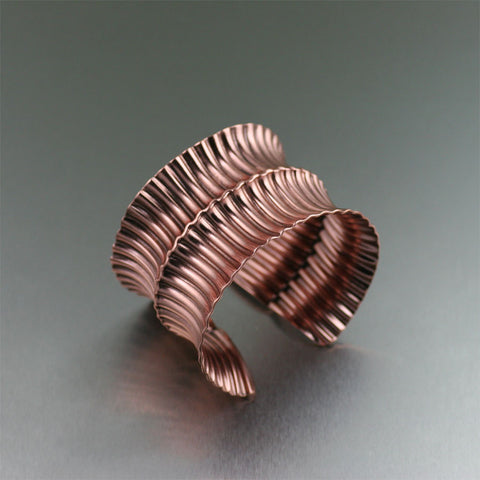
I tested this with a side-by-side design calculation for the Anticlastic Fold Formed Corrugated Copper Cuff, comparing a flat 18-gauge (1.02 mm) copper cuff blank with a corrugated 22-gauge (0.64 mm) blank, both 6 inches long and 1 inch wide. The metal weight dropped from 35 g to 24 g, about 31% lighter, while bending stiffness rose from 1x to 8x. In other words, the corrugated cuff comes out both lighter and stiffer, because its corrugations and anticlastic curve do the structural work instead of extra metal.
In our experience, the same principle makes fold forming ideal for large earrings. With the Copper Fold Formed Leaf Dangle Earrings and the Fold Formed Copper Lily Pad Earrings, a line fold creates the raised center vein. That vein stiffens the leaf, so we can use thinner sheet and keep each earring light. We also find that no two openings of a fold are ever identical. Each leaf unfolds with slightly different curves, which is why every pair is genuinely one of a kind.
Explore More Trends in Handmade Jewelry
Frequently Asked Questions
Q1. What metals does John S. Brana use for fold-formed jewelry?
John S. Brana creates fold-formed jewelry mainly in copper and aluminum, including copper cuffs, copper leaf and lily pad earrings, a copper shell necklace, and aluminum fold-formed leaf earrings.
Q2. Is fold-formed jewelry strong enough for everyday wear?
Yes. Hammering work-hardens the metal, and the folds and corrugations add stiffness, so fold-formed pieces hold their shape well even though they are lightweight.
Q3. How is fold forming different from traditional jewelry making?
Fold forming shapes a single sheet of metal by folding, hammering, annealing and unfolding it, with no soldering. Traditional fabrication usually cuts separate parts and solders them together.
Q4. How should I care for fold-formed copper jewelry?
Wipe it with a soft cloth after wearing and store it dry. Copper will develop a natural patina over time. If you prefer a bright finish, polish it gently with a metal polish, taking care around the folds and texture.
Q5. Which fold-formed pieces does John S. Brana offer?
Fold-formed designs include the Anticlastic Fold Formed Corrugated Copper Cuff, Copper Fold Formed Leaf Dangle Earrings, Fold Formed Copper Lily Pad Earrings, Corrugated Fold Formed Copper Leaf Earrings, a Fold Formed Copper Bangle with Brazilian Fire Agate, and a Fold Formed Copper Shell Necklace.

Also in Jewelry News Blog


Copper Bracelet Side Effects: Green Skin, Patina, and What Is Normal
Learn what is normal when wearing a raw copper bracelet, including green skin, patina, and natural color change over time. This article explains why these effects happen, how to reduce them, and how to care for uncoated copper cuffs so you know exactly what to expect from real copper jewelry.


Where to Buy a Real Copper Bracelet: What to Look For Before You Order
Shopping for a real copper bracelet can be confusing when listings use vague terms like “copper tone” or “copper finish.” Learn how to spot solid copper, choose the right cuff size, understand natural patina, and find a well-made bracelet that will hold up to everyday wear.


Copper Jewelry Myths Explained: What’s True, What’s Not, and Why People Still Believe Them
Copper jewelry has long been linked to comfort, wellness, and old family stories, but what does the evidence really say? This article clears up common myths about copper bracelets, green skin, patina, arthritis claims, and daily wear, while explaining why copper jewelry still holds meaning through style, ritual, and personal connection.