
How to Test Copper Jewelry: Solid or Plated? A Jeweler’s Guide


Key Takeaways
| Question | What I Want Buyers to Know |
|---|---|
| How can I tell if copper jewelry is real? | Check the product description, inspect existing wear, and ask for material documentation. |
| Does a magnet prove a bracelet is copper? | No. Copper is nonmagnetic, but many other metals are too. |
| Does fast tarnishing mean a bracelet is fake? | No. Tarnish is a surface reaction, not a purity test. |
| Does genuine copper have to be 99.99% pure? | No. A documented grade such as C11000 can be genuine solid copper below that percentage. |
| Can XRF confirm copper composition? | It can help identify elements, but a copper-rich surface reading may not establish the metal throughout the bracelet. |
| What do my mill reports show? | C10100 stock at 99.995% to 99.996% copper and C11000 stock at 99.97% to 99.98%. |
| What's the strongest evidence? | A relevant, traceable mill report, an appropriate laboratory test, or both. |
Introduction: Two Opposite Complaints Cannot Both Be Copper Purity Tests
“It tarnished immediately. It must be fake.”
“It didn't tarnish like my other bracelet. It must be fake.”
After more than 21 years of making handmade jewelry, I've heard both arguments. Neither tells me whether a bracelet is genuine solid copper. One customer sees spots and thinks the metal must be plated. Another sees a bright surface and reaches the same conclusion. Two opposite results cannot both serve as an authenticity test.
I started making jewelry in 2004, and I still make my pieces by hand in my San Francisco studio. I cut the metal, form it, hammer or chase the texture, shape the edges, and polish the finished piece. I've also had to learn how to explain what copper does after it leaves my workbench. That part is often less obvious than customers expect.
Learning how to test copper jewelry begins with three questions:
- Does the surface contain copper?
- Is the main body copper throughout instead of a plated base metal?
- And what grade and chemical composition can the seller actually substantiate?
Those are separate questions. A magnet, a photograph, and a single afternoon of wear cannot answer all three. In this guide, I'll explain which home checks are useful, why tarnish can mislead, what professional testing can tell us, and what my own copper mill reports say. I'll also describe how I think buyers and sellers can handle a disputed purity claim fairly.
1. What Does Genuine Solid Copper Jewelry Actually Mean?
Copper color is not a material specification
I see copper jewelry described in several ways: copper tone, copper finish, copper-plated, solid copper, and pure copper. These labels may sound alike, but they mean very different things. A copper-colored item might contain no copper at all. A copper-plated item has copper on the outside and a different material underneath. A solid-copper cuff uses copper as the body of the bracelet itself.
| Description | What it tells me | What still needs checking |
|---|---|---|
| Copper-tone or copper-colored | The item's appearance | The actual underlying metal |
| Copper-plated | Copper covers another material | The core material and plating thickness |
| Solid copper | The main body is copper throughout | The grade and reported composition |
| Copper alloy | Copper is mixed with other elements | The named alloy and accurate disclosure |
| 99.99% copper | A numerical composition claim | Evidence for that exact claim |
I also make jewelry using bronze and brass. Both contain copper, but neither should be passed off as pure solid copper. I can appreciate bronze for its color and brass for its look without pretending they're something else. Accurate labeling should be the easy part.
“Solid” and “pure” answer different questions
Solid describes how the piece is constructed. Purity describes the material's chemical composition. A bracelet can be solid copper from one edge to the other and have a certified copper content below 99.99%. Another bracelet can have a high-purity copper surface over steel or zinc. That doesn't make the entire bracelet solid copper.
A clear protective coating is different again. Some copper jewelry has lacquer to reduce contact with air and moisture. A coating doesn't automatically mean the metal underneath is plated. My copper cuffs are sold uncoated, while all copper earrings receive a protective finish. Those are choices about surface treatment, maintenance, and wearability, not ways of concealing the base metal.
I show the difference between the common product descriptions in my guide, Where to Buy a Real Copper Bracelet: What to Look For Before You Order.
My 3mm hammered cuff is made from the stock itself
When I make a narrow hammered cuff, I work directly on solid metal stock. I don't take an inexpensive bracelet and add a decorative copper skin. The hammer marks become part of the metal's surface. They don't reveal anything about the exact percentage of copper, but they do show how I shape and finish the piece.
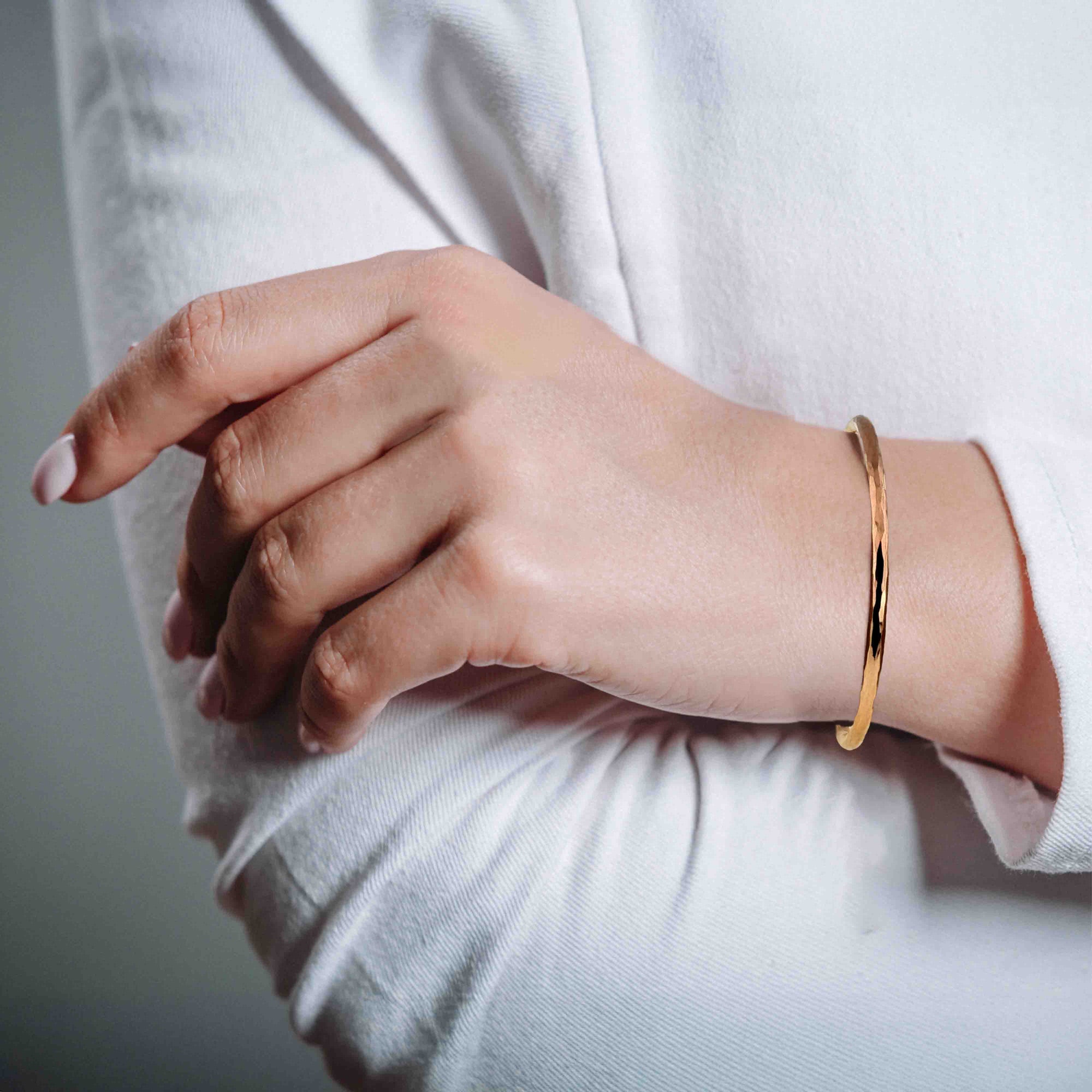
A picture can show workmanship, texture, and scale. It can't issue a chemical certificate. That's why I separate what a buyer can see from what the material records establish.
2. Does Genuine Copper Have to Be 99.99% Pure?
The grade matters more than a convenient percentage
A common misconception is that copper becomes fake as soon as its purity drops below 99.99%. I don't agree. Copper has recognized industrial grades, each with its own composition requirements. Two grades appear in the reports I supplied for this article: UNS C10100 and UNS C11000.
| Copper grade | Common name | Specified minimum copper |
|---|---|---|
| UNS C10100 | Oxygen-Free Electronic Copper | 99.990% |
| UNS C11000 | Electrolytic Tough Pitch Copper | 99.90% |
Both are genuine copper materials. C10100 carries a higher minimum and much tighter limits on certain impurities. C11000 is also widely used and can be formed, hammered, and fabricated into solid copper jewelry. A lower specified minimum isn't a declaration that the metal is counterfeit.
A grade minimum and a measured result aren't the same thing
Suppose a report identifies C10100, which has a specified copper minimum of 99.990%. A particular batch may measure 99.995% or 99.996%. The grade describes a requirement. The measured figure describes the tested material. I think a seller should make that distinction clear rather than treating the minimum as the laboratory result.
My Termomecanica documents show the same principle with C11000. The listed minimum is 99.90%, but the separate lots report 99.97% and 99.98% copper. I would describe those lots using the figures on their own certificates. I would not round them up to 99.99% merely because that number sounds more attractive.
Three claims that should never be confused
Imagine three sellers. The first advertises solid C11000 copper and supplies documentation showing a measured 99.97% copper content. The second promises 99.99% purity but provides no relevant records. The third describes copper plating over another metal as solid copper. These aren't equivalent cases.
The first seller has a supportable description, even though the documented percentage is below four nines. The second has an unverified numerical claim. The third has a construction claim that would be inaccurate if the bracelet is plated. The important issue is whether the description matches the actual material.
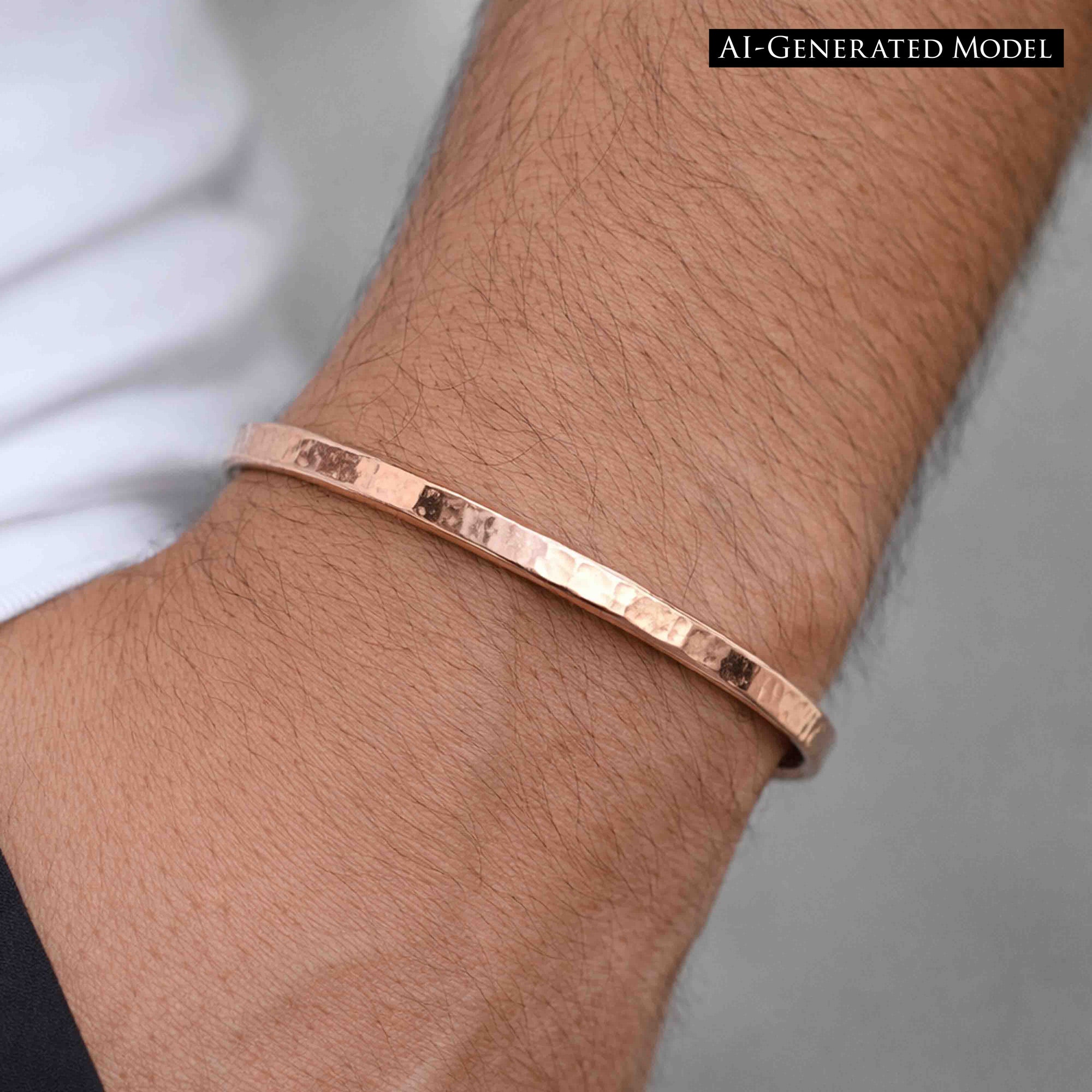
With a cuff like this one, I want the material claim and the workmanship claim to stand on their own. Hammering describes the finish. A relevant mill report supports the grade and composition. Neither one should be used as a substitute for the other.
3. How to Test Copper Jewelry at Home Without Damaging It
Start with the listing and the item's condition
Before taking out a magnet or polishing cloth, I recommend saving a copy of the original product description. Check exactly what the seller promised. Did the listing say solid copper, plated copper, or copper-colored? Did it mention a lacquer coating or a natural patina? A product that behaves exactly as disclosed shouldn't become suspicious simply because the buyer expected something else.
Next, photograph the whole item and any area of concern. I prefer a clear, evenly lit photo over a tight shot taken under harsh colored light. Don't file an edge, scrape away a patch, bend the bracelet open, or apply an improvised chemical treatment. Those actions can damage a piece without producing a trustworthy purity measurement.
The magnet test is a screening check
Copper isn't attracted to a normal magnet. If a magnet sticks firmly to the main body of a bracelet advertised as solid copper, I would ask more questions. Yet a magnet that doesn't stick proves very little. Brass, aluminum, bronze, and many other materials are also nonmagnetic or weakly magnetic under ordinary conditions.
A clasp or spring may also be made from a different metal than the rest of a piece. For a simple open cuff there are fewer components to consider, but the rule is unchanged: a magnet can identify a reason to investigate; it cannot certify the copper percentage.
Existing wear can sometimes reveal plating
If a plated bracelet has worn through naturally, there may be a contrasting underlying metal at an edge or high-contact area. A visible boundary between layers may also justify closer examination. I'm looking for an exposed core, not merely a change from bright orange copper to brown copper.
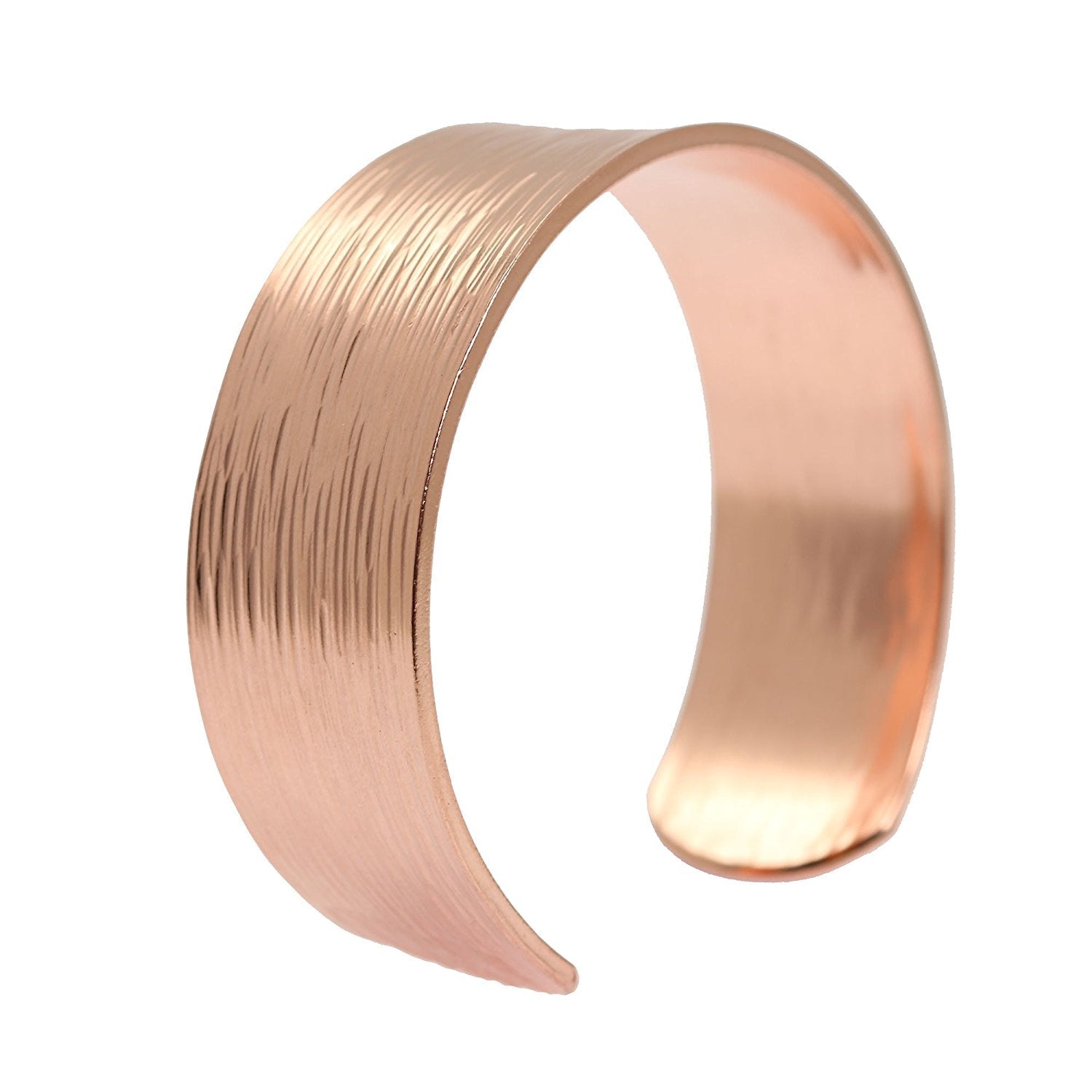
My chased copper designs are a useful illustration. Raised parts can catch the light while deep grooves appear darker. On a textured cuff, that variation is not proof that the finish is coming off. I'd inspect the actual material before calling a dark mark exposed plating.
Weight and cleaning have limits too
Copper has a density of about 8.96 grams per cubic centimeter. That makes weight helpful only when you compare pieces with similar dimensions and construction. A wide, thick cuff will weigh more than a narrow one. A hollow bracelet can't be judged like a solid band. A home density estimate will not reliably tell 99.995% copper from 99.996% copper.
Polishing is just as limited. Cleaning may remove tarnish from a copper surface, but copper plating can also be polished. A successful cleaning result doesn't identify the material beneath that surface. I don't recommend flame tests, acid tests, or deliberately scratching a finished bracelet as do-it-yourself authentication methods.
| At-home check | What it may show | What it cannot establish |
|---|---|---|
| Magnet | A strongly magnetic component | Solid copper or purity |
| Existing wear | A possible exposed plating core | Exact chemical composition |
| Weight comparison | A major mismatch between similar pieces | Four-nines purity |
| Surface color | A reason to ask a question | Metal grade |
| Tarnish | A surface reaction | Authenticity |
| Polishing | Removable discoloration | Underlying construction |
These are useful clues, not a pass-or-fail authentication system.
4. Why Tarnish Is Not a Copper Purity Test
“It tarnished immediately” doesn't prove a fake
Copper reacts to its surroundings. Moisture, perspiration, skin oils, lotion, soap, cleaning products, handling, storage, and air quality can all affect the surface. Two people can wear similar copper jewelry and see different changes. One person may develop spots quickly; another may have a bracelet that stays bright for quite a while.
I see this in my own work because polished copper shows marks so readily. A fingerprint can leave residue. A splash near a sink may dry unevenly. A cleaning product can alter the surface. None of those observations tells me that a copper cuff has a different metal core.
“It stayed bright” doesn't prove a fake either
If someone tells me that genuine copper must turn dark within a certain number of days, I ask how the bracelet was worn and stored. Was it recently polished? Was it protected by lacquer? Did it come into contact with much moisture? A coated piece may stay bright longer than an uncoated one, and an occasionally worn bracelet may look different from one worn every day.
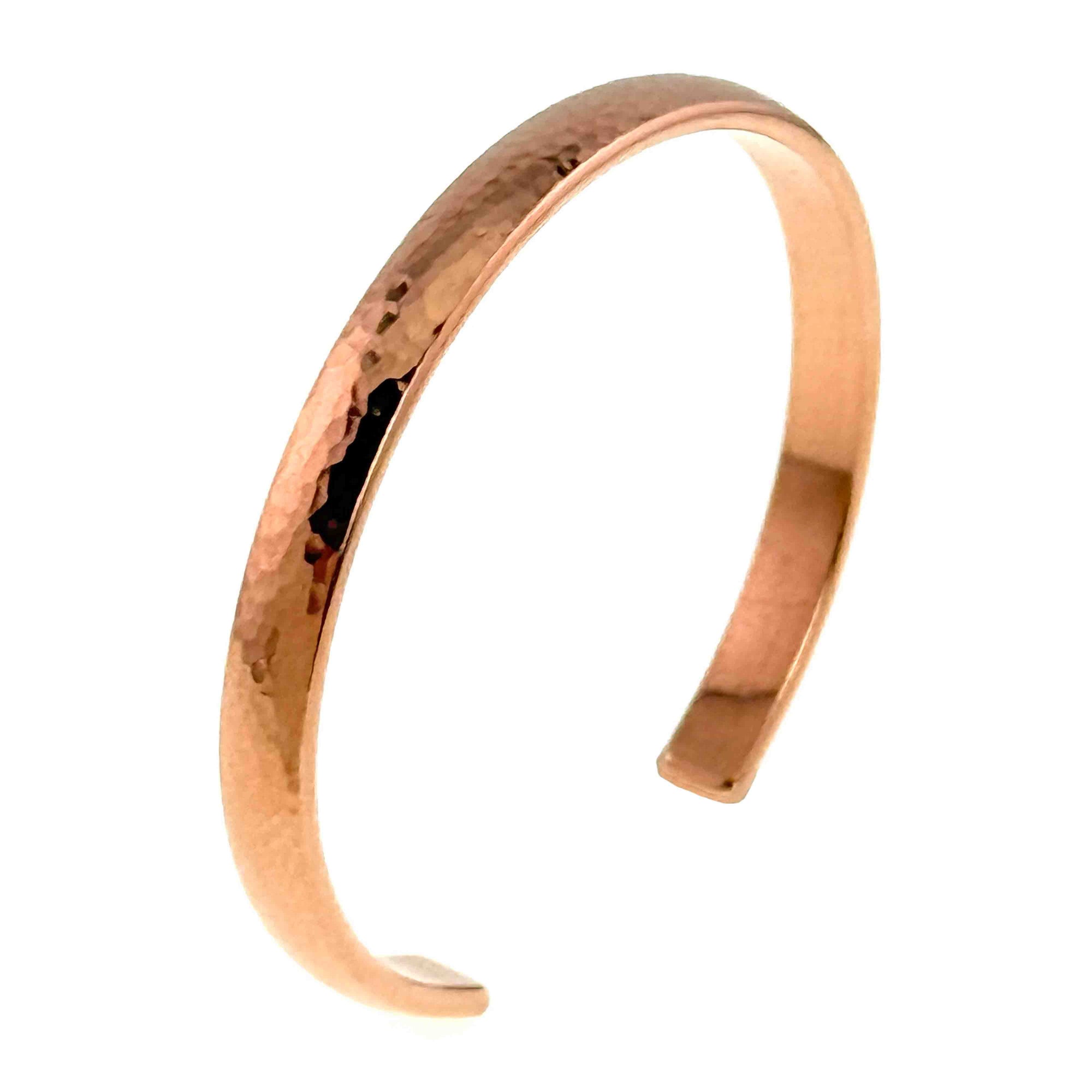
I leave my copper cuffs uncoated, so owners should expect a natural patina over time. The speed and pattern are not predictable enough to serve as a purity test. I can explain care, but I can't promise that two customers will get identical changes in color.
Green skin doesn't establish purity
Copper can react with substances on the skin and produce compounds that leave greenish marks. That reaction can occur with a copper-rich surface, including copper plating. It doesn't tell me whether the main body is copper, nor can it establish a numerical purity percentage.
A customer's old bracelet isn't a certified comparison sample either. Unless its grade, coating, finish, and wear history are known, it can't serve as a laboratory standard for a new purchase. I discuss the recurring misconceptions in Copper Jewelry Myths Explained: What's True, What's Not, and Why People Still Believe Them.
I make a simple distinction: tarnish tells me something happened at the surface. It does not tell me everything about the metal underneath.
5. Professional Copper Testing: What XRF Can and Cannot Prove
What an XRF instrument actually measures
X-ray fluorescence, usually called XRF, is a common method for identifying elements in metal. The instrument directs X-rays at the sample and measures characteristic signals associated with the elements present. In the right hands, it's useful for screening alloys and checking whether a tested area is consistent with a material claim.
One advantage is that XRF can often examine a finished item without damaging it. That makes the method appealing when someone has a jewelry dispute. But I always want to know what instrument was used, how it was calibrated, and how the result was interpreted.
Surface readings need careful interpretation
XRF is sensitive to the material within its measurement depth. If a bracelet has a copper-plated exterior, a copper-rich surface reading might not prove that the body is copper. Coatings, plating, surface contamination, sample shape, and instrument settings can influence the result. Some equipment and procedures can help characterize plating, but not every quick jewelry-store reading is designed to do that.
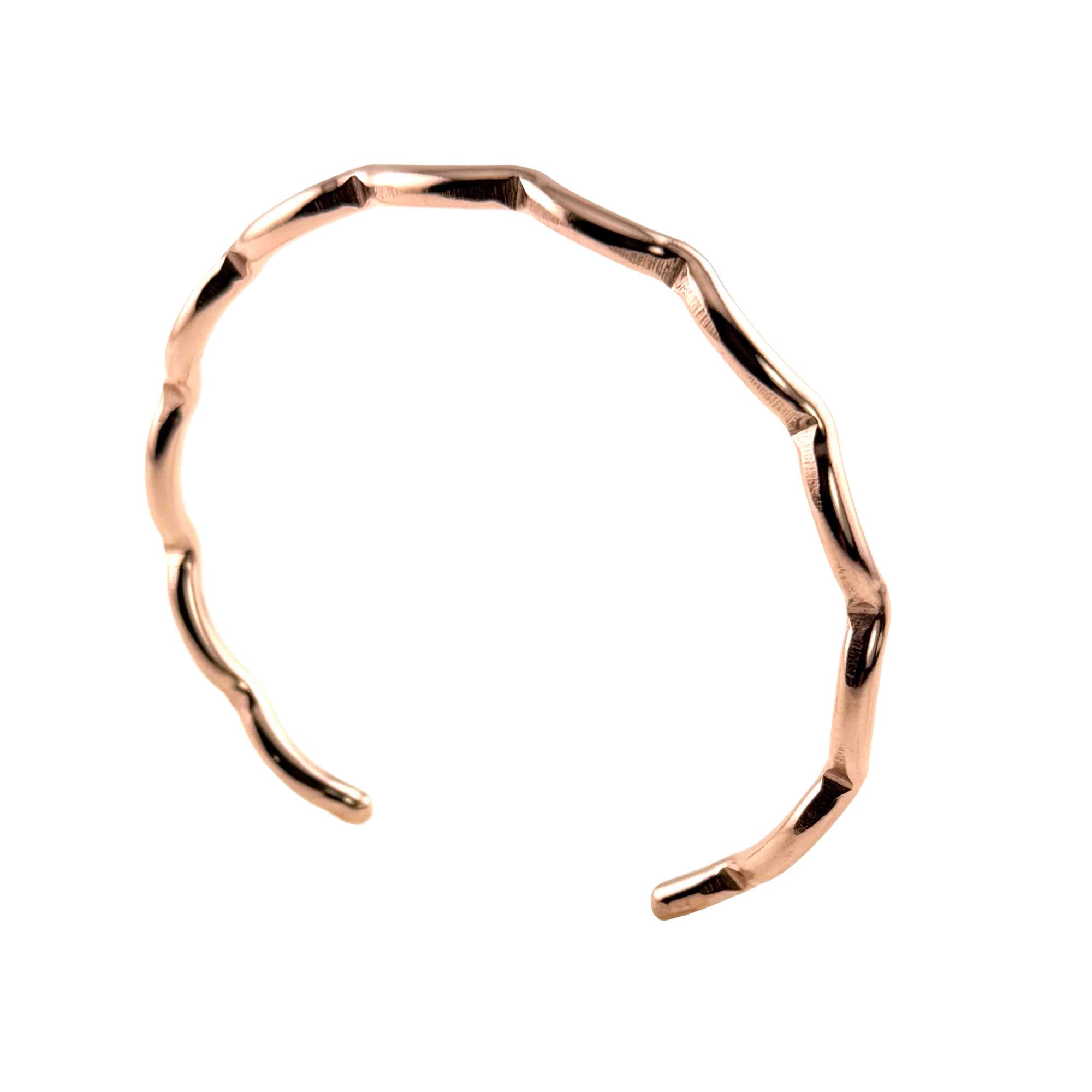
I pay particular attention to shape. A cuff with a broad flat area is easier to position than one with many angled facets. An operator should select a suitable measurement area and understand the geometry of the sample rather than assume every reading has the same reliability.
Measuring 99.99% copper calls for the right method
Identifying a copper-rich material is different from establishing very small amounts of impurities. A claim of 99.99% copper leaves only 0.01% for everything else combined. A laboratory must be able to measure the relevant trace elements with sufficient sensitivity and controlled uncertainty to support the grade being claimed.
For demanding trace work, a laboratory may use techniques such as inductively coupled plasma mass spectrometry, or ICP-MS. Depending on the method, a sample may need to be removed and chemically prepared. That can damage or consume a portion of the jewelry. I would discuss that risk before approving destructive analysis.
Questions I would ask before accepting a jeweler's conclusion
- What test method and instrument were used?
- Which part of the bracelet was examined?
- Was the surface prepared or cleaned?
- Did the examiner consider plating and coatings?
- What numerical results were obtained?
- Can the written report be provided?
- What does the method actually establish, and what remains uncertain?
A verbal opinion may be sincere, but it's not a substitute for a documented test result. If the concern is important enough to accuse a maker of selling counterfeit material, I think it's important enough to get the underlying facts.
6. What My Actual Copper Mill Reports Show
My supplied certificates contain different grades and results
I buy copper stock with inspection or quality reports that identify the material. For this article, I supplied four PDF files. One includes two C11000 lot certificates, while two Proterial PDFs refer to the same C10100 manufacturing lot. That means the five scanned pages document four distinct manufacturing-lot composition results, not five independent assays.
| Manufacturer and stock | Documented grade | Specified minimum | Reported copper | Production origin |
|---|---|---|---|---|
| Proterial, 3/16-inch round stock | C10100 | 99.990% | 99.996% | Japan |
| Proterial, second copy supplied for 5mm cuff stock (same lot 91V8892) | C10100 | 99.990% | 99.996% | Japan |
| Hitachi Metals, round stock | C10100 | 99.990% | 99.995% | Japan |
| Termomecanica, 1-inch rectangular strip, first lot | C11000 | 99.90% | 99.97% | Brazil |
| Termomecanica, 1-inch rectangular strip, second lot | C11000 | 99.90% | 99.98% | Brazil |
Original copper mill reports: scanned certificates
I have placed the actual report pages here so a buyer can read the grade and measured copper figure rather than take my word for it. Click any certificate image to open the original PDF. The scans show the underlying documents rather than a rewritten summary.

Proterial C10100, 3/16-inch round copper. 99.996% copper. The certificate identifies manufacturing number 91V8892, dated August 5, 2025, and a 99.990% grade minimum. This is the first copy of the Proterial lot report. View original PDF.


These values come from the actual reports, not from a general advertising claim. The two Proterial pages both identify manufacturing number 91V8892. Their matching 99.996% readings must not be counted as independent tests. The Proterial report dated August 5, 2025, shows 99.996% copper for C10100 stock. The Hitachi Metals report dated September 16, 2022, shows 99.995% for C10100. The Termomecanica quality certificates dated August 22 and October 3, 2024, record 99.97% and 99.98% for their respective C11000 lots.
I want to be exact here. An earlier article discussed a separate reported figure around 99.997%; that value should not be substituted for the composition reported on these supplied certificates. The reports do not establish one universal purity percentage for every copper design I've ever made. They document the particular stock identified in each report. That distinction protects customers from exaggerated claims, and it protects me from making claims my own records don't support.
What I check in a mill certificate
A useful report normally identifies the manufacturer, material designation, specifications, production or lot number, and chemical results. My supplied documents also include dates, stock dimensions, temper, and physical or mechanical measurements. That information makes it possible to determine what was actually tested.
A polished cuff won't display its chemical percentage on its surface. I need the material records for that. But a report for unrelated stock cannot honestly be used to certify a completely different product. This is why I want a traceable chain from the mill to the finished bracelet.
Traceability connects raw stock to finished jewelry

I think of the records in this order: identified mill stock → supplier paperwork → studio inventory records → production batch → finished cuff. The report documents the material. My production records need to connect that material to a particular item. If a separate laboratory tests the finished item, its results apply to the submitted sample within the scope of the test.
That may sound like a lot of detail for a copper bracelet. But if a seller is going to advertise a precise number such as 99.99%, the number should mean something. I don't see a reason to accept vague claims from one maker and demand exact documentation from another.
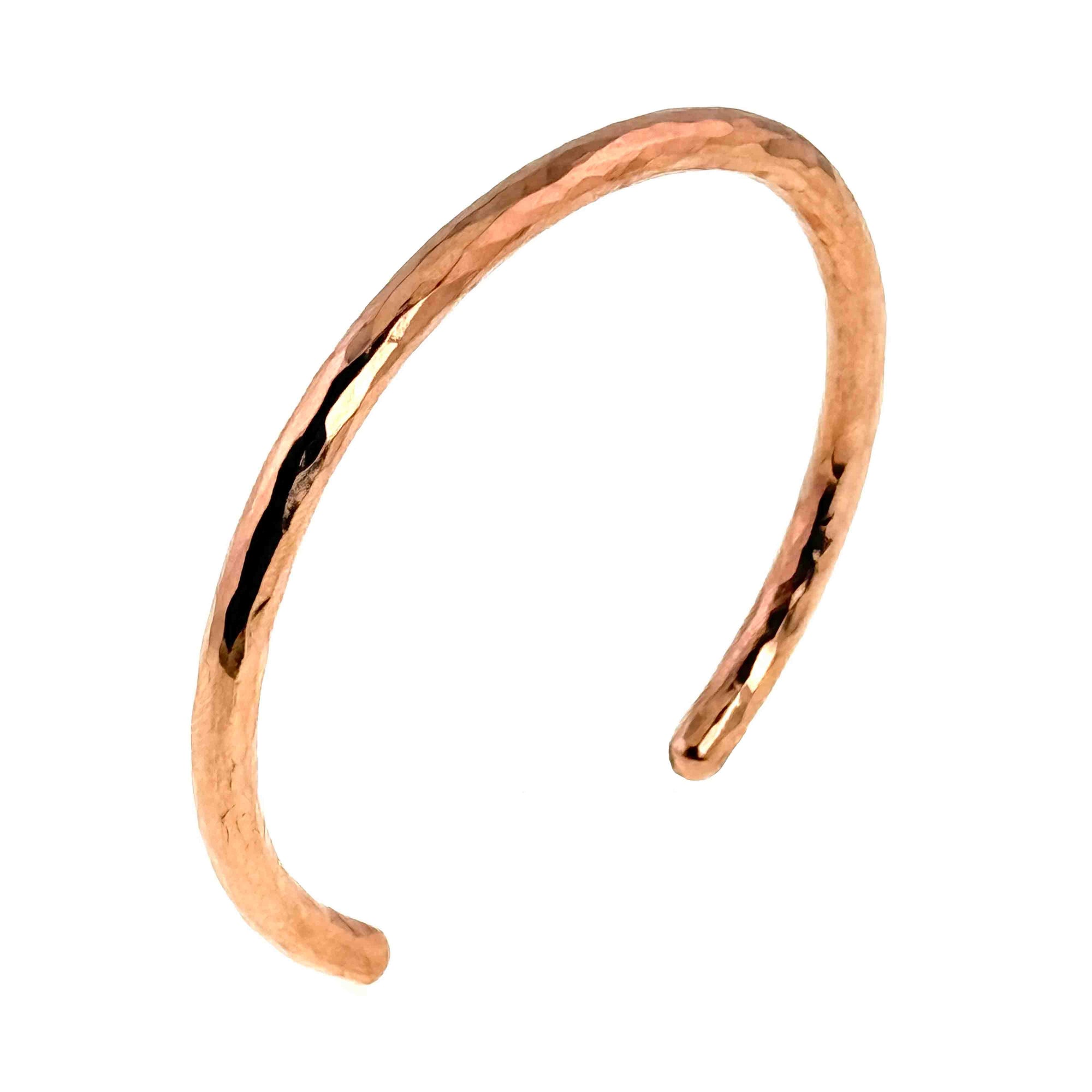
Different designs use different widths and profiles of stock. A product's width by itself doesn't establish which material certificate applies. I explain my approach further in How the Copper in My Jewelry Is Verified.
7. Pure Copper Claims, Country of Origin, and Missing Evidence
I ask the same questions regardless of where a bracelet was made
I sometimes hear buyers question copper jewelry made in India, China, or Turkey. I understand wanting reassurance when shopping with an unfamiliar seller. Still, the country of origin does not prove the composition of the metal. I would ask a manufacturer in Japan, Brazil, Turkey, China, India, or the United States the same basic questions.
What grade is the copper? Is the item plated or solid? What percentage is being claimed? Can the seller provide a report relevant to the supplied material? Those questions are more useful than assuming that a product is either good or bad because of its location.
Which sales claims deserve closer attention?
A listing that says “99.99% pure copper” without supporting documentation deserves a follow-up question. So does one that uses the words pure copper but never states whether the body is plated. A generic certificate is weak evidence if it cannot be linked to the stock used for the product being sold.
I also look for confusion between a specification minimum and a measured test result. If a supplier states that the material meets C10100 requirements, that says something important about grade. It doesn't mean the material happened to measure exactly 99.990%. The actual report should settle that part.
Missing documentation doesn't automatically prove deception. A small maker might buy legitimate copper without obtaining mill reports. But if that maker advertises a precise percentage, I think it's reasonable for the customer to ask how the number was established.
Finish quality is separate from copper composition
I judge workmanship by more than the purity figure. A well-made cuff has clean edges, a controlled shape, and a surface finish that suits the design. A bracelet can contain documented high-purity copper and still be badly formed. Another can be well formed yet poorly described by its seller.

With a textured anticlastic design, I pay attention to the curve, balance, and finish. Those are craft decisions. The copper grade is a separate material question. I want both things described accurately.
8. A Customer Dispute That Shows Why Evidence Matters
An Accusation of Fake Copper Without Supporting Evidence
In November 2026, I received a message from a customer who claimed that she had taken one of my copper cuff bracelets to a jewelry store, where a jeweler supposedly told her it wasn't real copper. She then accused me of scamming her.
After more than 21 years of designing and handcrafting jewelry, I take accusations about the authenticity of my materials seriously. My name is on the jewelry I sell, and I've built my business around honestly representing the metals I use.
I purchase copper from established suppliers and maintain mill inspection reports documenting its chemical composition. Those reports include C10100 oxygen-free copper with measured purity levels of 99.995% and 99.996%.
Naturally, I wanted to understand how a jeweler could conclude that one of my solid copper bracelets wasn't genuine.
Was the bracelet tested? What method was used? Did the jeweler have any experience identifying different copper grades? Was the conclusion based on an instrument reading or simply an opinion?
Those questions seemed reasonable to me.
What I Asked the Customer to Provide
I requested information that would allow me to identify the purchase and investigate the allegation.
| Information Requested | Why It Was Necessary |
|---|---|
| Complete Amazon order number | To identify the transaction and product |
| Photograph of the actual cuff | To examine the bracelet and its condition |
| Name and contact information of the jeweler | To verify the claimed assessment and understand how it was reached |
| Testing method or written findings | To evaluate the evidence behind the allegation |
Initially, the customer provided an incomplete order number and a photograph of the packaging rather than the bracelet itself.
After further correspondence, she eventually sent a photograph of the actual cuff.
The bracelet showed tarnishing, which is entirely normal for uncoated copper. Tarnish is a surface reaction, not evidence that a bracelet is plated or made from another metal.
With the photograph and purchase information, I was able to identify the cuff and trace the material used in its production to the applicable mill documentation.
The relevant report documented genuine copper. Nothing in the photograph established that the bracelet was counterfeit or falsely represented.
I also asked the customer on two separate occasions to provide the jewelry store's name and contact information so I could better understand the alleged findings.
She never supplied that information.
Instead, she eventually responded that she had already spent enough time dealing with the matter and didn't want to continue answering questions.
I found that response particularly frustrating.
After accusing me of selling fake copper and questioning my honesty, the customer treated my attempts to investigate her allegation as an unreasonable burden.
Did the Visit to the Jeweler Actually Happen?
This is the question I was left asking.
I don't know whether the customer actually visited a jewelry store. I don't know whether a jeweler examined the bracelet. And I certainly don't know whether any legitimate testing took place.
Despite asking twice, I never received the jeweler's contact information or a written explanation of how the alleged conclusion was reached.
That leaves open the possibility that the entire story about taking the bracelet to a jeweler was fabricated.
I cannot establish that it was. The customer may genuinely have visited a jeweler who gave her incorrect information. There may have been a misunderstanding about the metal, its tarnish, or the meaning of the jeweler's comments.
But without any identifying information or test results, I have no way to distinguish those explanations from the possibility that no such assessment ever occurred.
I don't think it's unreasonable to question an allegation when the person making it declines repeated opportunities to provide even basic supporting information.
The important distinction is that a claim can remain unverified without necessarily being false. I apply that standard to customers, jewelers, suppliers, and myself.
An Unexpected Development: She Purchased the Same Bracelet Again
What happened after the customer returned the supposedly counterfeit bracelet made the original accusation even more difficult to understand.
According to the Amazon order records, the customer originally purchased my 3mm Hammered Copper Cuff Bracelet in a 7.5-inch size on October 17, 2026. That order was subsequently returned before the 30 day window closed under Amazon's Return Policy and fully refunded.
Then, on November 7, 2026, just 21 days after her original purchase, she ordered the exact same bracelet in an 8-inch size.
The only difference was the size. Both bracelets were the same design, made from the same type of solid copper stock, and sold at the same $35 price.
This wasn't a matter of switching to a different material, design, or manufacturer. She purchased the same product again, simply half an inch larger.
I found that particularly revealing.
If the customer genuinely believed that a jeweler had determined my copper was fake, and felt strongly enough to accuse me of scamming her, why would she purchase another bracelet from the very same seller?
One reasonable possibility is that the original cuff was simply too small.
Another is that she reconsidered her concerns after I explained the copper's composition and the supporting mill documentation.
But I also have to consider the possibility that the story about visiting a jeweler was never true in the first place.
I asked twice for the jeweler's contact information and never received it. I was never provided with a test result, a written assessment, or any other evidence supporting the allegation.
Instead, the customer complained that she had already spent enough time on the matter, despite being the person who initially accused me of selling fraudulent merchandise.
I cannot establish whether the jewelry store visit actually occurred, and I won't claim to know the customer's intentions.
What I can establish is that the original cuff was refunded and the customer subsequently ordered the identical bracelet in a larger size.
That sequence doesn't prove deliberate deception, but it raises a reasonable question about whether the original complaint concerned copper authenticity at all.
The Bigger Problem: When Refund Claims Become a Way to Obtain Free Merchandise
Unfortunately, questionable return explanations are something I've encountered repeatedly during my years selling jewelry through Amazon and other online marketplaces.
Some customers report that an item is defective, damaged, counterfeit, or not as described. Many of those complaints are legitimate, and I have no problem correcting a genuine mistake.
But there are also situations where a customer may exaggerate or fabricate a complaint to obtain a full refund, avoid an applicable condition-based restocking fee, or, in more serious cases, receive a refund while keeping the merchandise.
That last possibility is particularly troubling.
When a customer obtains a refund through a knowingly false claim and keeps the merchandise, the seller loses both the product and the money.
For a small independent jewelry designer, that loss represents more than the retail price. There's the cost of the copper, the time spent making and finishing the bracelet, packaging, shipping, marketplace fees, and the work involved in investigating the complaint.
I've also encountered returns where jewelry showed signs of substantial wear or damage, while the customer maintained that the item was defective or arrived in that condition.
In some cases, explanations have changed after I've documented the returned merchandise and explained the reason for a permissible restocking fee.
I don't assume that every inconsistent explanation is deliberate dishonesty. But repeated experiences like these make it difficult to ignore the possibility that some customers are exploiting the protections intended for legitimate buyers.
The customer dispute I've described above is not proof of such a scheme. The original bracelet was returned and refunded, and I have no evidence that this customer kept merchandise without paying for it.
Still, the unsupported allegation about fake copper, followed by the purchase of the identical bracelet in a larger size, illustrates why I believe sellers need to investigate questionable claims rather than accept every accusation at face value.
Another Common Concern: Claims That a Delivered Package Never Arrived
Another frustrating issue I've encountered involves customers reporting that an order never arrived, even though the carrier's tracking information shows it was delivered.
I've dealt with situations where USPS tracking records confirm delivery, sometimes including a specific date, time, and location such as a front door or porch, only for a customer to contact me claiming the package is missing.
I take those reports seriously because delivery problems do happen.
A carrier may scan a package incorrectly, deliver it to the wrong address, or leave it somewhere unexpected. Packages can also be stolen after delivery.
That's why I encourage customers to check with household members, neighbors, building management, and their local post office. When appropriate, I recommend opening a USPS service request or Missing Mail Search.
But there's another possibility that sellers cannot ignore: a customer may claim an item wasn't received despite having received it, hoping to obtain a refund or replacement without returning anything.
These claims can be particularly difficult for a seller to investigate independently.
I cannot personally verify what happened at someone's doorstep hundreds or thousands of miles away. I have to rely on carrier records, the available evidence, and the applicable marketplace procedures.
A delivery confirmation doesn't prove that a customer is lying, but an unsupported claim of nonreceipt doesn't automatically establish that the seller failed to fulfill the order either.
When someone knowingly makes a false nonreceipt claim to obtain a refund while keeping the delivered item, that's not a harmless customer service misunderstanding. It's an attempt to obtain merchandise without paying for it.
And the financial burden may ultimately fall on the seller.
Why Online Shopping Needs Accountability on Both Sides
Amazon and other major marketplaces have made buying and returning merchandise remarkably convenient. I understand why customers appreciate that convenience. I benefit from reaching buyers through those platforms myself.
But I worry that the ease of requesting refunds can create opportunities for abuse.
A return or refund system should protect someone who receives the wrong item, a defective product, or merchandise that was genuinely misrepresented.
It shouldn't reward someone who knowingly provides false information.
There is a difference between being dissatisfied with a purchase and inventing a reason to obtain a refund.
There's also a difference between a package genuinely going missing and falsely claiming that a delivered order never arrived.
I don't believe these behaviors describe most online shoppers. Over more than two decades, I've served thousands of customers who have been thoughtful, honest, and appreciative of my work.
But the dishonest behavior of even a small number of buyers can create real costs for independent businesses.
I've spent more than 21 years building my jewelry business and developing the skills needed to work with copper and other metals. Every handmade bracelet represents time, materials, and individual craftsmanship.
I don't expect customers to keep products they don't want. I don't expect anyone to overlook a legitimate defect or accept an incorrect material description.
I do expect a reasonable degree of honesty when someone requests a return, reports a delivery problem, or accuses me of selling counterfeit jewelry.
Customer protection should never mean that a seller has no right to question inconsistent claims, examine returned merchandise, or request evidence before accepting a serious accusation.
The Lesson: Evidence and Accountability Must Work Both Ways
The customer who accused me of selling fake copper ultimately returned her bracelet, declined to identify the jeweler who supposedly questioned its authenticity, and then purchased the identical design in a larger size.
I cannot prove that her original allegation was fabricated. I can only describe the documented events and explain why they raised questions.
But the experience reinforced something I've come to believe strongly after more than two decades in the jewelry business.
Honesty cannot be a one-way obligation.
If I advertise a bracelet as solid copper, I should be able to substantiate that claim with relevant material documentation.
If a customer believes the metal is counterfeit, it's reasonable to ask what evidence supports that conclusion.
If a package is reported missing, both the carrier's tracking records and the customer's account deserve appropriate consideration.
And if a customer returns used or damaged jewelry, the item's actual condition should determine whether a deduction is justified under the applicable return policy.
Fairness means protecting honest customers from dishonest sellers while also protecting honest sellers from fraudulent claims.
I don't think that's too much to ask.
If the problem with a bracelet is simply that it doesn't fit, tell me. I'm happy to explain the available sizes and initiate an exchange.
If there's a genuine defect, let me investigate it.
If a package is missing, provide the information needed to work with the carrier.
But please don't turn an ordinary sizing issue, a normal copper surface reaction, or an otherwise straightforward transaction into an unsupported accusation of fraud.
The jewelry business depends on trust. That trust has to go both ways.

9. Has Convenient Online Shopping Changed Customer Accountability?
An observation from years of selling handmade jewelry
After more than two decades of selling my work, I worry that some marketplace interactions now move from suspicion to certainty too quickly. That's an observation from my own experience, not proof that every buyer behaves badly or that society as a whole has declined. Many of my customers are thoughtful, patient, and interested in learning how their jewelry is made.
What concerns me most is how some customers are willing to distort the facts to justify a complaint or avoid paying a legitimate restocking fee. After more than 21 years in the jewelry business, I've encountered my share of questionable claims, particularly through Amazon. A customer may insist that a bracelet isn't genuine copper because it tarnished, blame a natural surface reaction on defective craftsmanship, or change the reason for a return after learning that a restocking fee applies. Others cite an unnamed jeweler's opinion but refuse to provide the testing method, a photograph of the actual product, or even a complete order number.
What I find particularly disheartening is the apparent willingness of some people to misrepresent the circumstances of a purchase simply to avoid taking responsibility for how they treated or returned an item. I've received jewelry showing clear signs of wear, damage, or improper handling, only to have customers insist that it arrived that way. When I ask for documentation or explain why a condition-based restocking fee was assessed, a straightforward business matter can quickly turn into an accusation of dishonesty.
I don't assume every dissatisfied customer is being deceptive. Many have legitimate concerns, and I take those seriously. But repeated experiences with contradictory explanations and unsupported allegations have made me increasingly concerned about the erosion of personal accountability in online shopping. Amazon has made purchasing and returning products remarkably convenient, but convenience shouldn't mean that sellers are expected to absorb every loss regardless of the circumstances.
There's a difference between exercising your rights as a customer and misrepresenting the facts to avoid the consequences of your own actions. I believe honesty, fairness, and accountability should apply equally to buyers and sellers. Unfortunately, some of my experiences suggest that those principles aren't always respected.
A handmade item still involves real work
It's easy to click a purchase button and just as easy to start a return. I use online marketplaces myself, and I value that convenience. But the bracelet still has to be cut, formed, textured, finished, inspected, and packed. When an item returns, a person still needs to examine it and handle the paperwork.
I don't think customers owe a seller blind belief. I do think both parties owe one another a fair chance to examine the evidence. If a seller makes an inaccurate claim, the seller should correct it. If a buyer alleges misrepresentation, the buyer should be willing to share the basis for that allegation.
Standards should apply equally to sellers
I don't get to excuse a weak material claim because I've been making jewelry for years. Experience can help me explain metalworking, but it doesn't replace documentation. If I say a certain batch measures 99.996% copper, I should be able to show which report supports that figure and how that material relates to the jewelry in question.
I want buyers to hold other sellers to that standard too, without jumping to conclusions based on price, appearance, or country of origin. Clear questions usually lead to better answers than accusations.
10. Returns, Damaged Jewelry, and What Makes a Refund Fair
Not every change in copper is damage
I understand that a buyer may decide a cuff isn't the right size or style. Returns are part of selling jewelry online. I handle them according to the applicable store or marketplace policy. At the same time, the condition of a returned item matters.
I've received cuffs that were bent out of shape, pieces showing substantial wear, and packages with missing care cards or damaged gift boxes. Those situations can require cleaning, inspection, reshaping, or replacement packaging. A badly altered cuff may no longer be suitable for sale as new.
But I don't treat every tarnished surface as abuse. Copper can naturally darken with wear and exposure. I look at the whole condition of the item, the original disclosures, the nature of any changes, and the circumstances of the return.
Why I document returns
I photograph returned items when condition is relevant to a refund decision. That helps me explain what was received rather than speculate about what someone did with the bracelet. Documentation matters whether the return was handled through my own site or a marketplace.
A condition-based deduction should reflect the item received and the applicable policy. It shouldn't be a penalty for asking a question or submitting a complaint.
Amazon restocking rules have limits
Amazon's U.S. seller guidance doesn't permit unrestricted restocking fees. An item returned within policy in its original condition generally should not incur a restocking fee. Certain late returns or buyer-caused damage may allow a deduction within the applicable limits. Returns caused by seller error or a defective or incorrect item must be treated differently.
| Return situation | How I think it should be handled |
|---|---|
| In-policy return in original condition | Follow the full-refund requirements |
| Buyer-caused damage or use | Document the condition and apply only permitted deductions |
| Wrong or defective item supplied by seller | Don't penalize the buyer for seller error |
| Missing packaging materials | Document what is missing and apply the specific policy |
| Tarnished copper | Judge the actual condition rather than assume misuse |
I want a fair process, not an automatic fee. I also believe customers should read product care instructions and return terms before buying, especially with metals that change appearance through normal use.
11. A Better Process for Resolving Copper Authenticity Concerns
When a buyer questions the copper in a bracelet, I think the process should begin with the least disruptive steps. Not every concern needs expensive laboratory work. The first task is to identify the item and understand the precise complaint.
- Preserve the condition. Don't deliberately scratch, file, or chemically treat the bracelet.
- Photograph the concern. Include a full view and a close-up of the area in question.
- Identify the purchase. Provide the correct order reference and product name.
- Describe the observation. Explain whether the concern is tarnish, weight, color, visible wear, or an outside opinion.
- Request relevant documentation. Ask for material records connected to that stock or production batch.
- Obtain written findings. If a jeweler performed a test, ask for the method and numerical result.
- Consider independent analysis. Choose a laboratory method suitable for the specific claim if the dispute remains unresolved.
- Follow the return policy. A buyer who doesn't want the item can pursue an eligible return without having to prove that fraud occurred.
I would rather see someone send two clear pictures and a short explanation than damage a bracelet trying to authenticate it. And I would rather receive a written test report than spend days debating an unsupported opinion.
My approach is practical: questions are welcome; conclusions should follow the investigation. I apply that rule to my work and would recommend it to any buyer dealing with an unfamiliar jewelry seller.
12. What I Ask Buyers to Check Before Ordering Solid Copper Jewelry
Before buying, I recommend checking the material claim carefully. If the listing says only copper-colored, I wouldn't assume it's solid copper. If it says 99.99% pure copper, I would want to understand whether that's a grade requirement, a batch result, or a number repeated from a supplier's marketing description.
Here are the questions I'd save before purchasing:
- Is the main body solid copper, or does the item have a copper-plated core?
- What copper grade is used, if known?
- Is the stated percentage a specified minimum or an actual reported result?
- Is a relevant mill report or laboratory result available?
- Can the seller connect the document to the product's material stock?
- Is the surface coated or uncoated?
- What color changes and patina should I expect?
- How should the piece be cleaned?
- What size is appropriate for the wrist?
- What return conditions and deductions may apply?
- Should I buy copper jewelry if I have sensitive skin?
Purity isn't the only buying consideration
I spend as much time thinking about wearability as I do about texture. A bracelet with beautiful metal and poor sizing isn't comfortable. I usually recommend measuring around the wrist just below the wrist bone and adding about half an inch for comfort. A 6.5-inch wrist would generally point to a 7-inch cuff.
I also advise customers to roll a cuff onto the wrist rather than repeatedly pulling the ends apart. Repeated bending can alter the shape and work-harden the metal. Thickness and width matter too. A slim cuff feels different from a broad, shaped design, even if both are made from the same copper grade.
For a wider look at my work, you can visit John S. Brana Handmade Jewelry, browse my handcrafted jewelry collection, see the copper jewelry collection, or compare the available solid copper cuff bracelets.
I want someone to buy the design that fits their needs, with a clear understanding of the metal. Good workmanship, sensible sizing, honest composition claims, and realistic care instructions all matter.
Conclusion: Ask for Documentation and Be Willing to Examine It
I don't ask customers to accept a purity claim because I've spent more than 21 years making jewelry. I ask them to look at the relevant evidence. My supplied reports show C10100 copper at 99.995% and 99.996%, and C11000 copper at 99.97% and 99.98%. Each result belongs to its identified stock. I don't think those figures should be mixed together to create a more convenient marketing claim.
Copper can darken quickly or stay bright. It can leave color on skin or remain relatively unchanged. None of those observations replaces a traceable mill report or an appropriate laboratory test. The same applies to an opinion given at a jewelry store without a written method or results.
A seller should substantiate what is advertised. An accusation of misrepresentation should have a factual basis too. I think that is a fair standard for everyone involved.
If you have a question about the material in a John S. Brana cuff, send me your purchase information and a clear photograph. I can then identify the piece and review the relevant records.
Frequently Asked Questions About Copper Jewelry Testing
How can I test copper jewelry without damaging it?
I would first review the product description, check for existing wear, try a magnet as a screening clue, and take photographs. None of those steps should damage the bracelet. Exact composition may still require traceable documentation or suitable professional testing.
Does a magnet prove my bracelet is solid copper?
No. Copper isn't attracted to an ordinary magnet, but many other jewelry metals aren't either. A magnet that sticks strongly to the bracelet body raises questions. A magnet that doesn't stick does not settle them.
Does fast tarnishing mean my copper bracelet is fake?
No. Copper can react quickly with sweat, soap, moisture, and other environmental exposure. I would inspect the surface and review care instructions before calling the material into question.
Does green skin prove a bracelet is pure copper?
No. Copper on the surface of jewelry can produce greenish residue, even if the underlying item is plated. That reaction doesn't establish solid construction or a numerical percentage.
Is 99.9% copper genuine copper?
Yes. C11000 is a recognized copper grade with a 99.90% minimum copper requirement. My supplied certificates show C11000 lots with actual measured results of 99.97% and 99.98%.
Can an XRF test certify 99.99% pure copper?
It depends on the instrument, setup, sample, impurity limits, and measurement uncertainty. I would ask the laboratory to explain whether its method can support the claimed grade rather than assume a handheld reading is sufficient.
Can a copper-plated item produce a copper XRF reading?
Yes. A copper-rich outer layer can produce a strong copper signal. The operator must consider coating thickness, test depth, and the possibility of a different underlying metal.
What should a copper mill report contain?
I look for the manufacturer, date, grade, applicable specification, lot or manufacturing identifier, and chemical composition results. Dimensions and mechanical test results can help connect the report to the stock being supplied.
Does one mill report prove the purity of every bracelet a seller makes?
No. The report covers identified material stock or lots. The seller needs a reasonable way to connect that material to the finished pieces being discussed.
Are copper bracelets made in China, India, or Turkey automatically less pure?
No. Country of origin doesn't establish composition. I would ask for the same grade information and appropriate supporting evidence from sellers in any country.
What if a jeweler says my bracelet isn't real copper?
I would ask for the test method, the measured results, and a written report. I'd also identify the bracelet and examine relevant material records before drawing a conclusion.
Why might a damaged return receive less than a full refund?
That depends on the item's condition and the applicable return policy. I document returned condition, distinguish natural patina from damage, and don't treat restocking deductions as a penalty for raising a concern.

Also in Jewelry News Blog


Copper Bracelet Side Effects: Green Skin, Patina, and What Is Normal
Learn what is normal when wearing a raw copper bracelet, including green skin, patina, and natural color change over time. This article explains why these effects happen, how to reduce them, and how to care for uncoated copper cuffs so you know exactly what to expect from real copper jewelry.


Where to Buy a Real Copper Bracelet: What to Look For Before You Order
Shopping for a real copper bracelet can be confusing when listings use vague terms like “copper tone” or “copper finish.” Learn how to spot solid copper, choose the right cuff size, understand natural patina, and find a well-made bracelet that will hold up to everyday wear.


Copper Jewelry Myths Explained: What’s True, What’s Not, and Why People Still Believe Them
Copper jewelry has long been linked to comfort, wellness, and old family stories, but what does the evidence really say? This article clears up common myths about copper bracelets, green skin, patina, arthritis claims, and daily wear, while explaining why copper jewelry still holds meaning through style, ritual, and personal connection.